Level9
level9os.com ↗AI for Operations · the product house

Organizations should
work as beautifully
as the people inside them.
Architect
Built the systems I wished existed.
Architect
Built the systems I wished existed.
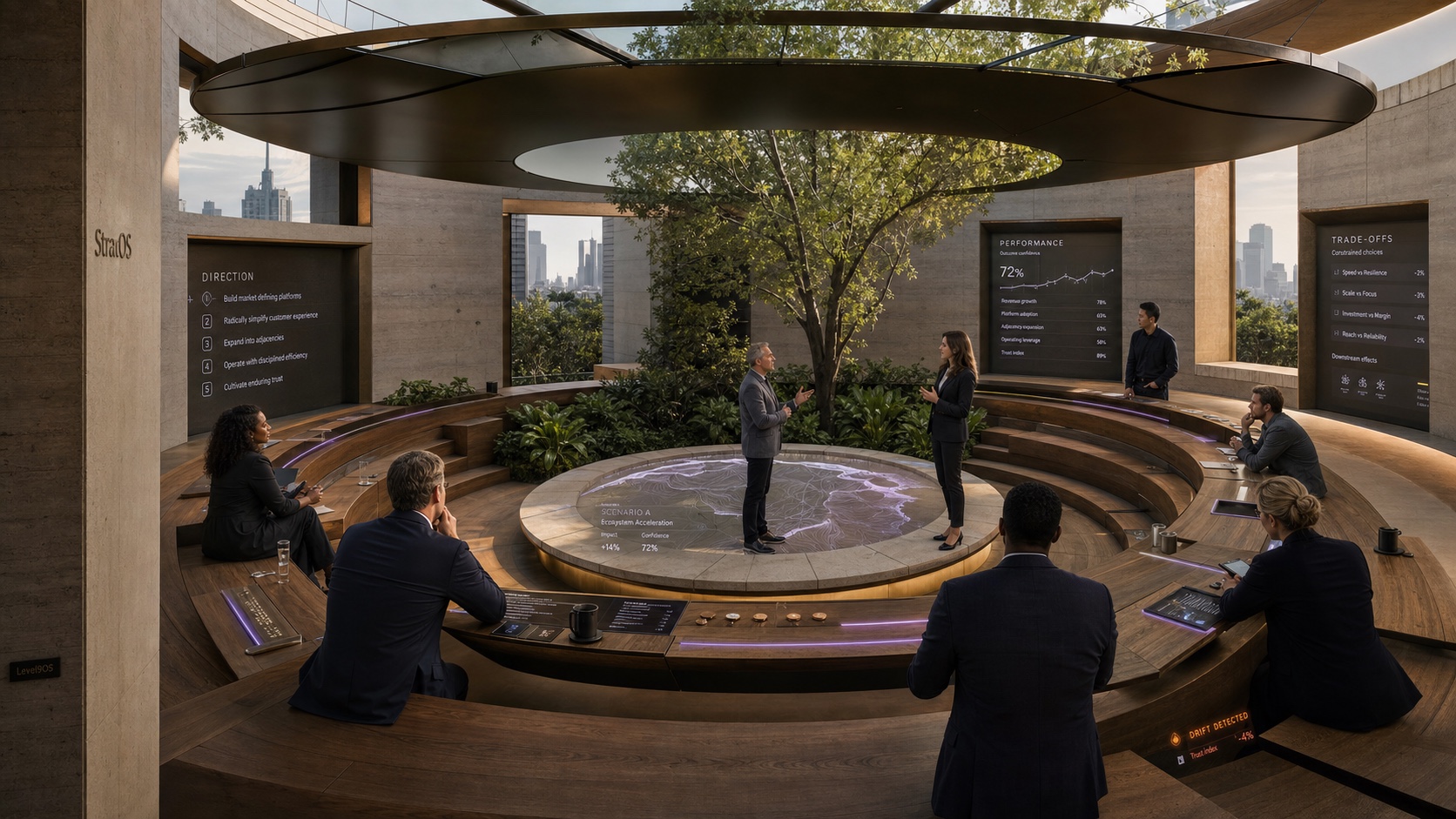
10-person simulated exec room. 3 rounds. Kill criteria built in.
Build
Three continents. Nine markets. Zero playbook. Built it anyway.
Scale
Enterprise to AI. From managing to measuring to building.
The architecture
behind the builds.
Decades of operational experience across six continents. Five industries. Countries where the decision had to hold before the wire went through. The builds on level9os.com didn't come from a boardroom slide. They came from being in every room where the slide failed.
If it doesn't work for us, running our own businesses on our own operations, we don't release it. Period.
Before the builds, the operator.
The minimum required to build a platform for operations, not the résumé line, the prerequisite.
Every era wrote its own
version of AI. Shipped code in all of them.
The tools changed. The operating problems didn't. Every entry below is a real role, a real stack, and a real scar that made the current architecture specifically possible.
The AI-safety language was Ada. The rooms still just nodded.
College. BA in International Relations with a minor in hardware and software. Shipped code on a VAX in Ada, the DoD's safety-critical AI language of record. Tasking, contracts, enumerated types, the era's agentic discipline. Pre-internet, pre-cloud, pre-everything that would eventually let the back-office catch up.
“Codebases didn't fail because the syntax was wrong. They failed because the seven people in the room agreed too fast.”
Mono-Lite. S&P Global. Credit Suisse. Country management in three regions.
First build at Mono-Lite in Montana. Then Standard & Poor's, Managing Director for Southeast Asia out of Hong Kong. Then Credit Suisse, CEO for the Czech Republic out of Prague. Empty offices to full operations, three times. Rolled out the first back-office platforms: PeopleSoft, Siebel, Tableau, early CAD. C++ and Java arrived, did little with them.
“Strategy doesn't fail in strategy. It fails in the handoff between the slide and the person in the third time zone who has to execute it on Monday morning.”
H&H Management. Incubators, M&A, system and people integration.
Global managing partner at H&H Management out of Montana. Deep inside incubators, mentoring founders, advising on M&A, system integration, and people integration across the first wave of internet businesses. Three post-acquisition integrations run personally. Hundreds of leaders mentored through the dotcom cycle and out the other side.
“The deal doesn't close the integration. People do. The leader who can't see the operating friction a quarter out is the leader whose deal fails eighteen months later.”
Microsoft. T-Mobile. Running operations at Fortune 100 scale.
Enterprise operations leadership across Microsoft Worldwide Public Sector (94 offices unified) and T-Mobile (marketing analytics at scale). Network, subscriber, and business ops at a scale where every decision in a conference room of ten had to hold for a company of hundreds of thousands. Every function had a platform by this point. Marketing had automation. Sales had CRM. Finance had models. Operations had a new slide template.
“Scale changes the problem. A decision in a room of ten had to hold across time zones, languages, and a workforce big enough to be its own country.”
Zoot. The scale era. Startups. The modern SaaS stack finally arrives.
Scale and startup operations at Zoot. Marketing transformations. The first wave of modern SaaS (Azure, HubSpot, Notion, Snowflake, Looker) finally gave every team a stack, except the team running the company. Every tool had an opinion about operations and none of them were built for operations.
“Every function got its platform. Somebody had to build the operating layer. The consultants weren't going to, the problem doesn't have a billable hour.”
GPT-4. Claude. n8n. Supabase. Finally cheap enough to compose.
The pieces to build the operating layer finally became composable. What took a team of twenty in 2008 now takes one operator and a model array. The tooling gap closed for anyone willing to write the composition layer themselves. Started building.
“Hours instead of quarters. The gap between knowing what to build and being able to build it shrunk by a factor of a thousand.”
Forty-eight domain officers. Three governance gates. Dogfooded daily.
CommandOS in production. Three leadership-tier agents (coordinator, health, project manager) supervise a fleet of forty-eight domain officers across strategy, creative, sales, people, technical, research, and governance. Automatic session rotation. Multi-LLM routing. Every decision audited. Every dollar budgeted. Running on the live company. Breaking and healing in public, because that's the only honest way to ship this.
“If it doesn't work for us, running our own businesses on our own operations, it doesn't ship to anyone else.”
Misalignment compounds.
Then it kills you.
Every org I ran broke the same way. Misalignment at the top, drag in the handoffs, cost accumulates in execution, leadership goes reactive, and the cycle repeats. Every quarter, every company that doesn't have something explicit breaking it.
The four pressure points below are the only four places the cycle actually gets interrupted. Governance is the chassis underneath, not a fifth slot, the foundation every intervention sits on.
Four places to break the cycle.
One chassis that runs through all of them.
Full product stories live on level9os.com. The full 4 → 8 → 8 mapping (pressure points → operating layers → playbook domains) is at level9os.com/architecture. This is the architectural spec, why these four, why this order, why governance sits under all of them.
Misalignment
Decide.
Pressure-test the decision before it ships. Ten-person simulated executive room. Three rounds. Kill criteria up front.
Drag
Coordinate.
Agents managing agents. Three leadership tiers supervise 48 domain officers. Session rotation. Multi-LLM routing.
Cost
Execute.
Umbrella over three pods. LinkupOS for LinkedIn signal. ABM Engine for multi-channel outbound. AutoCS for customer care. All governed, voice-calibrated, small monthly footprint.
Reactive leadership
Measure.
Execution Capability Index. Four pillars, 37 intervention levers. Real-time friction detection.
Audit trail · budget enforcement · quality gates · secrets vault · AEGIS-aligned · OpenTelemetry traces · policy-as-code. Not a line item, not a tab, not a “we'll get to that.” The foundation every decision, every dispatch, and every dollar sits on.
Teaching. Keynotes.
Board work. Time given away.
Builds on level9os.com aren't the only output. Adjunct teaching at MSU's Jake Jabs School of Business (senior-level 401 class, not MBAs). 20+ keynotes across Europe, Asia, and the US on automation in the enterprise. Board advisory across incubators, investor groups, and startups. A consistent habit of giving time to challenged individuals, veterans, founders, and students. Credibility isn't a line on a resume. It's a consistent pattern of showing up where you don't bill.
20+ years of training.
One operating system.
Level9OS is what happens when the tooling gap finally closes and an operator with decades of scar tissue decides to build instead of wait for the vendor.

“Every era wrote its own version of AI. The interfaces change. The operating problems don't. If it doesn't work for us, we don't release it. Period.”

Montana kid. Six continents.
Still building.
I grew up in Montana with the kind of curiosity that doesn't sit still. Left home, lived on four continents, visited sixty countries, and spent 20+ years in executive operating roles: building organizations, breaking them, fixing them, and eventually figuring out why most of them don't work as well as the people inside them.
This isn't a resume. You can find that on LinkedIn. This is the version that explains why I do what I do.
20+ years. 6 continents. One throughline.
First build. Technology leadership before startup culture existed.
Six countries, nine markets. 20%+ market share growth through strategic M&A.
30%+ margin increase. Operational architecture IS the common language.
35% execution efficiency increase. 3 post-acquisition integrations. Mentored hundreds of leaders.
94 offices unified at Microsoft. Built analytics at T-Mobile. Doubled operational throughput at both.
Enterprise scale across every time zone. 20%+ engagement increase, 25% rework reduction.
Stopped fixing other people's systems. 6+ commercial AI products in production. Adjunct at MSU.

“The system is the language.”
My first real test was Prague. Credit Suisse sent me to build their Czech operation taking over from a lead management scandal, and I didn't speak Czech. What I learned: when you can't rely on a common spoken language, you build systems that communicate for you. Operational architecture doesn't need translation. It IS the translation.
“Self-correcting beats supervised. Every time.”
Six countries across Southeast Asia. Six completely different business cultures. I tried to manage them individually and nearly burned out. Then I built one system that self-corrected, and watched it outperform everything I'd ever managed hands-on. That's when alignment stopped being a nice idea and became the entire thesis.
“Misalignment compounds exponentially.”
At Microsoft, with 100+ global stakeholders, I saw something that changed how I think about scale: a 5% misalignment at headquarters becomes a 50% gap by the time it reaches the field. Nobody notices until it's too expensive to fix. At T-Mobile, I built the analytics to make it visible. At Zoot, I codified it. If it's not written, it's not real. It's just hope.
“If you need a transformation, you already lost.”
I stopped fixing other people's systems and started building the ones I wished existed. That became Level9 OS: the operating layer the modern business actually runs on. 6+ commercial AI products in production. StratOS pressure-tests strategic decisions. CommandOS orchestrates the agent fleet. LucidORG measures operational friction, co-founded with my daughter Sasha.
On the shifts. The scars. The forward.
Operator-grade thinking, three lenses, M/W/F.

How To Keep AI Agents From Deleting You
“Three months from now, most organizations will not be dealing with smarter models. They will be dealing with faster mistakes.”

AI Agent Scalability and The Structural Gap
“Enterprise AI has crossed the inflection point. We are no longer debating whether to adopt agentic systems; we are managing the liability.”

Addressing LLM Personality Development
“Something strange happens when you push an LLM agent hard. Get impatient with it, and the output quality degrades.”
Monday · Wednesday · Friday. Three lenses. One operator.